
Monday, June 30, 2014
Facebook Psychology Study Scandal: BS Science to Prop BS Technology
I've got better things to do than write about Facebook's questionable practices (or Facebook in general, or any other social networking site for that matter). So, this is going to be a short rant.

Wednesday, May 21, 2014
Dun Mares and Black Stallions: Another Look at Applicant Tracking Systems
Allow me to start from afar. Take a look at the screenshot of a Google ad that kept popping up in my Gmail inbox. It appears that, having been sifting through thousands of my emails for eight or nine years now, the world's #1 search engine and online advertiser "thinks" I am a flirty plus-size female who likes knitwear, has anger issues, and may be a little slow in the head:
 I guess I don't need to worry about my privacy.
On the other hand... a Taoist tale many of us are familiar with thanks to J. D. Salinger comes to mind (in case you don't remember, see below):
Joking aside, what I am trying to say - yet again - is that computers, although impressively fast, are still disappointingly dumb, and that they perform very poorly when it comes to processing human language, which is inherently ambiguous. To make things even harder for computers, humans often make it even more ambiguous.
In fact, in June 2011, having introduced Schema.org (initiated by Google), the world's four leading search engines pretty much admitted that they do not have production-ready technology capable of "understanding" what a web page really means and tried to off-load part of the job onto webmasters (humans) by encouraging them to add semantic markup to their web pages. I have written about it before, so I am not going to go into detail here again.
So much for the introduction.
On the other hand... a Taoist tale many of us are familiar with thanks to J. D. Salinger comes to mind (in case you don't remember, see below):
-
Duke Mu of Chin said to Po Lo: "You are now advanced in years. Is there any member of your family whom I could employ to look for horses in your stead?" Po Lo replied: "A good horse can be picked out by its general build and appearance. But the superlative horse - one that raises no dust and leaves no tracks - is something evanescent and fleeting, elusive as thin air. The talents of my sons lie on a lower plane altogether; they can tell a good horse when they see one, but they cannot tell a superlative horse. I have a friend, however, one Chiu-fang Kao, a hawker of fuel and vegetables, who in things appertaining to horses is nowise my inferior. Pray see him." Duke Mu did so, and subsequently dispatched him on the quest for a steed. Three months later, he returned with the news that he had found one. "It is now in Shach'iu" he added. "What kind of a horse is it?" asked the Duke. "Oh, it is a dun-colored mare," was the reply. However, someone being sent to fetch it, the animal turned out to be a coal-black stallion! Much displeased, the Duke sent for Po Lo. "That friend of yours," he said, "whom I commissioned to look for a horse, has made a fine mess of it. Why, he cannot even distinguish a beast's color or sex! What on earth can he know about horses?" Po Lo heaved a sigh of satisfaction. "Has he really got as far as that?" he cried. "Ah, then he is worth ten thousand of me put together. There is no comparison between us. What Kao keeps in view is the spiritual mechanism. In making sure of the essential, he forgets the homely details; intent on the inward qualities, he loses sight of the external. He sees what he wants to see, and not what he does not want to see. He looks at the things he ought to look at, and neglects those that need not be looked at. So clever a judge of horses is Kao, that he has it in him to judge something better than horses." When the horse arrived, it turned out indeed to be a superlative animal.
-
-- J. D. Salinger, Raise High the Roof Beam, Carpenters
Joking aside, what I am trying to say - yet again - is that computers, although impressively fast, are still disappointingly dumb, and that they perform very poorly when it comes to processing human language, which is inherently ambiguous. To make things even harder for computers, humans often make it even more ambiguous.
In fact, in June 2011, having introduced Schema.org (initiated by Google), the world's four leading search engines pretty much admitted that they do not have production-ready technology capable of "understanding" what a web page really means and tried to off-load part of the job onto webmasters (humans) by encouraging them to add semantic markup to their web pages. I have written about it before, so I am not going to go into detail here again.
So much for the introduction.
Monday, March 31, 2014
When Marketing Budgets Hugely Exceed Those of QA: Thoughts Triggered by Yet Another Bug-Ridden Applicant Tracking System
If advertisers spent the same amount of money on improving their products
as they do on advertising, they wouldn't have to advertise them.
Will Rogers
Around 2008, I became interested in Applicant Tracking Systems or, rather, what I thought back then an ATS should do and how it should do it. I even toyed with the idea of developing my own, but the interest must have been not strong enough for this idea to go beyond a modest in-house working prototype used to train students. I am still interested in this type of software applications, which now manifests itself mostly in what I call a recurring irresistible itch to find bugs in them (Once a Software Tester, Always a Software Tester). So, here is one for your... amusement.
Let's say you are an employer using an ATS from a reputable SaaS (software as a service) provider.
A job seeker visits your web site, goes to its career section and from there is taken to your ATS.
-
Note: Technically, it isn't really your ATS since you just "rent" a "slice" on a multi-tenant ATS provided by a SaaS vendor. The applicant may or may not be aware of the fact that he/she is using third-party software, which depends, among other things, on how tightly the ATS is integrated into your web site and how familiar with this type of systems he/she is.

Screenshot 1 (click to enlarge)
In case you didn't get it, let me show you another one. The screenshot below is from the site of another company, but the ATS SaaS provider and the bug are the same (pay attention to where the red arrows are pointing):

Screenshot 2 (click to enlarge)
Friday, February 28, 2014
Recruiter Spam (and Some Labor Statistics)

There are multiple varieties of recruiter/sourcer spam, but one of my "favorite" is when the e-mail begins with "Our records indicate that you are an IT professional..." followed by a copy-pasted job description that usually is not even remotely related to what I am qualified to do. More often than not the job description is pretty skimpy and/or vague, which is even more annoying.
-
Being a naturally curious type, I decided to find out how many people in this country the phrase "IT professional" applies to.
Saturday, January 25, 2014
IT-Averse Senior Management? There's a Workaround for That
Last week, I was talking to someone, and - totally unexpectedly - two situations I had completely forgotten about resurfaced in my memory.
Situation #1
Quite a few years ago.
I am sitting in the office of an old friend of mine, who owns and runs a successful business. His company is larger than what in Europe they call a "medium-sized enterprise", but not huge. As a person, he is, quite possibly, the nicest businessman I've ever met. You should see how courteous he is with the cleaning lady... but I digress...
So, we are sitting in his office chatting about his business. He is telling me about some of his challenges, and I am throwing ideas (naturally, the IT kind) back at him - just to keep the conversation going. Even though I am careful enough not to get too technical, I can tell by the look on his face that he does not understand much of what I am saying. Then, looking a little embarrassed, he confesses that all of it is totally over his head, that he "hardly knows anything about computers", and that he only occasionally uses his "obscenely expensive, but mostly useless, laptop to send personal e-mails".
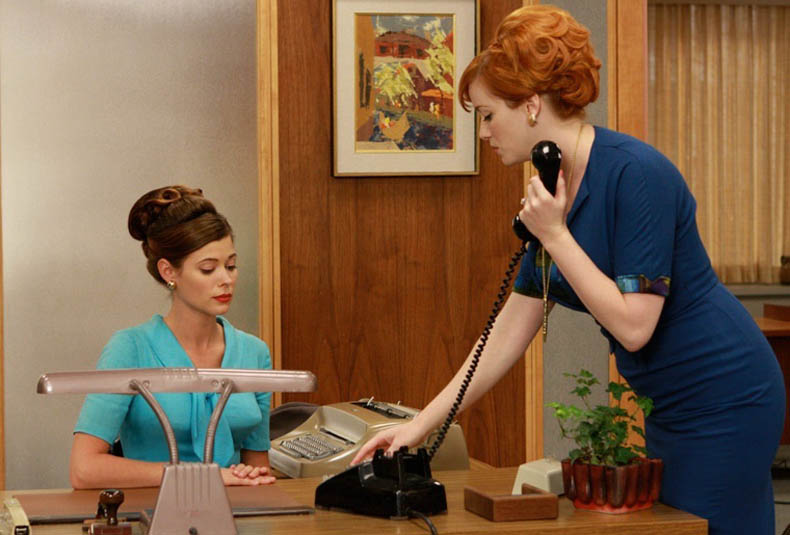
As tactfully as I only can, I inquire if this (I can barely stop myself from using the word "disability") complicates his professional life. "Not at all," he replies cheerfully. "At work, I have a girl for that," he adds pointing at the door behind which is the office of his administrative assistant.
This was before AMC's Mad Men. Otherwise, I would have thought I was at Sterling Cooper.

Situation #1
Quite a few years ago.
I am sitting in the office of an old friend of mine, who owns and runs a successful business. His company is larger than what in Europe they call a "medium-sized enterprise", but not huge. As a person, he is, quite possibly, the nicest businessman I've ever met. You should see how courteous he is with the cleaning lady... but I digress...
So, we are sitting in his office chatting about his business. He is telling me about some of his challenges, and I am throwing ideas (naturally, the IT kind) back at him - just to keep the conversation going. Even though I am careful enough not to get too technical, I can tell by the look on his face that he does not understand much of what I am saying. Then, looking a little embarrassed, he confesses that all of it is totally over his head, that he "hardly knows anything about computers", and that he only occasionally uses his "obscenely expensive, but mostly useless, laptop to send personal e-mails".
As tactfully as I only can, I inquire if this (I can barely stop myself from using the word "disability") complicates his professional life. "Not at all," he replies cheerfully. "At work, I have a girl for that," he adds pointing at the door behind which is the office of his administrative assistant.
This was before AMC's Mad Men. Otherwise, I would have thought I was at Sterling Cooper.
Image from The Watcher, a Chicago Tribune TV blog by Maureen Ryan
Image from AMC Blogs
-
Note: In order to be completely objective, I have to explain that, in the country where this conversation took place, the word "girl", although not entirely appropriate in workplace context, did not sound as terribly politically incorrect as it would have in the U.S.
Subscribe to:
Posts (Atom)